
Invisible Oceans: The Silent War Over Maritime Data
ASIAAMERICAOCEANIAEUROPEAFRICA
Thomas Dos Remedios
5/21/20264 min read
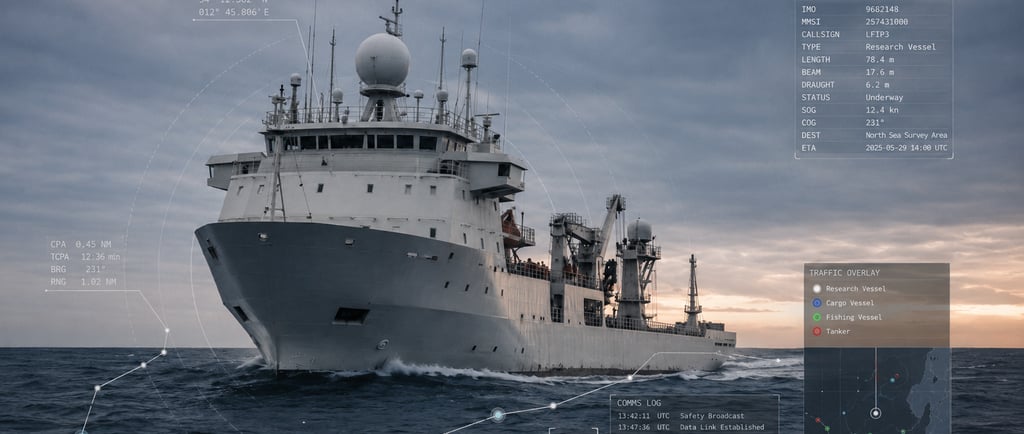
On the surface, the oceans have never been more transparent. In the age of satellites and real-time tracking, every ship seems traceable, every route identifiable, every flow under control. Yet behind this illusion of total visibility, a discreet but transformative phenomenon is taking shape: the deliberate manipulation of maritime tracking systems.
AIS spoofing, which involves falsifying or hijacking ship identification signals, reveals a profound transformation in contemporary maritime geopolitics. Far from being marginal, this phenomenon contributes to the emergence of a partially invisible maritime space, where data becomes unreliable and surveillance imperfect. In this context, a question arises: are we witnessing the formation of a digital “gray zone” in the oceans, one that eludes traditional control mechanisms?
MASSIVE MARITIME TRANSPARENCY... BUT INHERENTLY FRAGILE
The introduction of AIS, made mandatory in the early 2000s by the International Maritime Organization, has profoundly transformed maritime governance. Today, more than 100,000 commercial vessels continuously transmit AIS signals, enabling near-constant monitoring of shipping traffic. This infrastructure has become central to the global economy. Platforms like MarineTraffic process more than 20 billion ship positions per day, while companies like Spire Global operate satellite constellations to cover the entire globe, including areas far from the coast.
This accumulation of data has fueled a vision of a maritime space that is now “readable.” As researcher Christian Bueger, a specialist in maritime security, points out, “we live under the illusion of a transparent sea, made visible by digital technologies.” However, this transparency rests on a fragile technical foundation. AIS is neither encrypted nor secure, and can be manipulated directly at the source. A study by the Center for Advanced Security, Strategic, and Integration Studies has shown that it is possible, with limited resources, to generate false AIS signals or hijack existing ones.
In other words, maritime transparency rests on a paradox: the more data there is, the more its reliability becomes a critical issue.
THE RISE OF A "FARK FLEET" : STATISTICS AND THE STRUCTURE OF A PARALLEL
It is against this backdrop that a parallel maritime economy has developed, built around practices of concealment and circumvention. AIS spoofing plays a central role in this. Since the tightening of sanctions against Russia in 2022, the number of ships involved in so-called “opaque” activities has risen sharply. According to estimates by the Royal United Services Institute, the Russian oil “dark fleet” comprises between 600 and 1,000 ships, representing nearly 10% of the global tanker fleet.
These ships are believed to transport several million barrels per day, representing a significant portion of Russian exports. They employ a combination of techniques: deliberately turning off the AIS, data manipulation (spoofing), and ship-to-ship cargo transfers at sea. The phenomenon is not limited to Russia. Iran and Venezuela also use these practices to maintain their exports. According to analyst Sal Mercogliano, “the dark fleet has become a structural element of global energy trade, and no longer an anomaly.” This shift reflects a paradigm shift: invisibility is no longer a risk to be avoided, but a resource to be exploited.
A MARITIME DATA CRISIS : TOWARD SYSTEMIC UNCERTAINTY
One of the most profound effects of AIS spoofing lies in the deterioration of the quality of maritime information. Whereas AIS once promised an accurate representation of maritime traffic, it has now become a source of uncertainty. In certain strategic areas, anomalies are widespread. In the Black Sea, several reports have identified hundreds of cases of spoofing, with ships appearing at impossible locations or simultaneously at multiple points. As early as 2019, more than 9,000 ships were affected by GPS anomalies within a few days in this region.
This proliferation of inconsistent data creates a major problem: that of reliability. As maritime security expert Timothy Heath points out, “in a data-saturated environment, the challenge is no longer obtaining information, but distinguishing the true from the false.” We are thus witnessing a desynchronization between physical reality and its digital representation. Data flows continue to exist, but their visibility becomes uncertain, fragmented, and sometimes manipulated. This situation introduces a form of systemic uncertainty that affects both governments and economic actors.
TANGIBLE ECONOMIC REPERCUSSIONS
The lack of visibility into maritime traffic does not merely have abstract consequences: it generates immediate and measurable economic costs that directly affect businesses, governments, and consumers. In a system where nearly 90% of global trade is transported by sea, even the slightest uncertainty regarding a ship’s position can disrupt an entire logistics chain.
The first impact concerns marine insurance. When a ship turns off its AIS or exhibits inconsistent course patterns, it is automatically considered high-risk. As a result, certain cargoes become difficult to insure, or see their premiums skyrocket. On certain routes involving ships suspected of belonging to the “dark fleet,” insurance costs can amount to as much as 10 to 15% of the cargo’s value, compared to 0.1 to 0.5% under normal circumstances. In some cases, insurers simply refuse to cover the voyage, forcing operators to use alternative routes that are more expensive and less secure.
Furthermore, AIS spoofing directly disrupts the operations of ports and logistics terminals. When a ship reports an incorrect position or arrival time, it throws port scheduling into disarray: lost berthing slots, idled cranes, and increased congestion. In major port hubs, where every call is scheduled down to the hour, just a few hours of uncertainty can be enough to trigger a cascade of delays. This results in additional costs for handling, storage, and contractual penalties for shipowners.
The impact is also very tangible for industries dependent on a continuous flow of raw materials. A refinery waiting for a tanker whose location is uncertain may be forced to slow down production or even make emergency purchases on the spot market at a higher price. Similarly, in the manufacturing industry, a delivery delay caused by an unknown route can bring an entire production line to a standstill. In a just-in-time model, just a few days of uncertainty are enough to generate significant losses.
Thomas Dos Remedios, for SPECTIO
The statements made are solely those of their authors and do not reflect the position of the Think Tank Spectio.