
Eleusis versus Piraeus: Greece at the heart of the Sino-American standoff
EUROPE
Thomas Dos Remedios
12/28/20255 min read
THE RETURN OF PORTS TO THE CENTER OF MEDITERRANEAN GEOPOLITICS
For several decades, European ports were viewed almost exclusively as tools for economic development, integrated into a globalization process that was supposed to be fluid, apolitical, and fundamentally beneficial. This view has gradually been shattered. The Covid-19 pandemic, Sino-American trade tensions, the war in Ukraine, and energy crises have revealed a harsher reality: the infrastructure that organizes flows is also what structures power relations. In this context, the eastern Mediterranean has regained a strategic centrality it had not seen since the Cold War.
Greece, long considered a fragile periphery of the European Union, now finds itself at the heart of this realignment. Its geographical position, at the crossroads of Europe, the Middle East, the Balkans, and the Black Sea, makes it an essential transit point for goods, energy, and military flows. Greek ports, particularly those around Athens, are no longer just national infrastructure: they have become hubs of global networks, observed and coveted by the major powers.
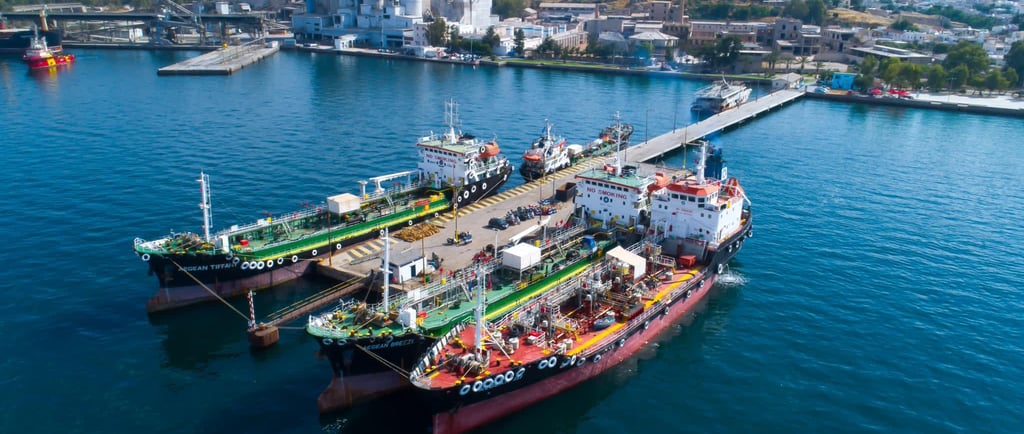
The expansion of the Eleusis shipyard, approved by the Greek Parliament in the fall, is fully in line with this dynamic. Presented as an industrial and social project, it actually reveals a more profound transformation of Greece's place in the international political economy, where the distinction between investment, security, and influence is becoming increasingly blurred.
ELEUSIS, FROM INDUSTRIAL PERIPHERY TO STRATEGIC PLATFORM
Eleusis has long remained on the sidelines of the grand narratives of globalization. An industrial city marked by pollution, deindustrialization, and social crisis, it symbolized the limits of the Greek economic model before and after the debt crisis. Its shipyard, once a pillar of the local economy, had gradually sunk into financial difficulties, becoming an abandoned asset. Its acquisition by the American group Onex was initially presented as an industrial rescue operation, likely to recreate jobs and revitalize a marginalized area.
But the $125 million in support granted in 2023 by a US government agency changed the way the project was viewed. Washington's direct intervention, through a financing instrument closely linked to US foreign policy, gave Eleusis a scope that goes far beyond the local context. This type of public commitment is only mobilized when strategic interests are at stake. Eleusis thus becomes an anchor point, a long-term investment in a maritime area considered sensitive.
The Greek Parliament's vote authorizing the expansion of the site and the diversification of its activities confirms this development. By integrating logistics, energy, and defense-related functions, Eleusis is changing its status. It is no longer simply a matter of producing or repairing ships, but of integrating the port into a broader architecture of traffic flows. Its location reinforces this logic. Its proximity to a military airport, major road and rail links, and regional logistics centers allows for flexible use of the site, enabling it to adapt quickly to both civilian and military needs.
In an international environment marked by uncertainty and fragmented supply chains, this versatility is a major asset. Eleusis thus appears to be a discreet response to a central problem: how to reduce dependence on a limited number of entry points without abruptly upsetting the existing balance.
THE PIRAEUS, SYMBOL OF A NOW CONTROVERSIAL GLOBALIZATION
A few kilometers from Eleusis, the port of Piraeus embodies another trajectory, that of rapid and profoundly transformative globalization. Since COSCO acquired a stake in the port in 2016, the site has undergone a spectacular transformation. Chinese investment has modernized infrastructure, increased container handling capacity, and integrated Piraeus into the major trade routes connecting Asia and Europe. In just a few years, the port has become one of the most important on the continent, surpassing many historic hubs. For China, Piraeus represents much more than an economic success. It is a European bridgehead, a privileged access point that shortens logistics times and secures exports to the European market. The long-term concession, which runs until 2052, enshrines this presence in a strategic timeframe based on stability and continuity. Through Piraeus, Beijing is not just trading: it is becoming a permanent fixture in the physical structures of the European economy.
This success, long hailed as an example of win-win cooperation, is now being reevaluated in light of new international tensions. The control of critical infrastructure by a foreign public company is now raising questions about sovereignty, security, and long-term decision-making capacity. Piraeus appears less as a simple engine of growth than as a focal point of dependencies, potentially exposing Greece, and, beyond that, the European Union, to forms of indirect influence.
A RIVALRY THAT IS BECOMING MORE AND MORE OPEN
This change in perception has recently led to increased diplomatic tension. Public statements by US officials criticizing China's presence in Piraeus marked a break with their previous cautious approach. By denouncing Chinese control of infrastructure deemed strategic, Washington has clearly indicated that the Greek issue is now part of a broader confrontation with Beijing. The Chinese reaction, denouncing interference and calling for the port's economic character to be preserved, shows how porous the boundary between economics and geopolitics has become. What was once presented as a commercial investment is now perceived as a security issue. Greece thus finds itself at the center of an exchange of signals between two powers seeking to impose their interpretation of the world. Faced with this growing pressure, Athens is adopting a cautious stance. The Greek government insists on respecting the agreements concluded with China, while emphasizing the possibility of developing other ports with Western partners. This strategy aims to avoid exclusive alignment and preserve room for maneuver in an increasingly polarized environment. It also reflects a structural reality: for a medium-sized state, multiplying options is often the only way to limit the costs of rivalry between major powers.
PORTS, ENERGY, AND SECURITY: THE RECONFIGURATION OF GREECE'S ROLE
Eleusis is not an isolated case. American interest in other Greek ports, notably Alexandroupoli, reveals a more comprehensive approach linking logistics, energy, and regional security. Located near the Black Sea, Alexandroupoli has established itself as a strategic transit point for NATO forces and as an energy hub thanks to its liquefied natural gas terminal. In the context of the war in Ukraine and the West's desire to reduce its dependence on Russian gas, this port has taken on new importance. Through these infrastructures, Greece is gradually transforming itself into a regional platform for both energy and logistics. This development strengthens its strategic weight, but also exposes it to greater international tensions. Greek ports are becoming spaces where commercial interests, security imperatives, and influence dynamics intersect. They are no longer just tools for national development, but key elements of regional and transatlantic systems.
FLOW CONTROL AS A NEW CHALLENGE TO SOVEREIGNTY
In this context, the issue of flow control is becoming increasingly important. Revelations about fraudulent import networks, concerns about industrial espionage, and European debates on economic security have contributed to changing perceptions of ports. They are now seen as places of vulnerability as much as prosperity. The coexistence of ports with different functions, such as Piraeus and Eleusis, can be interpreted as an attempt to better manage these vulnerabilities. While Piraeus remains a mass commercial hub, Eleusis could host more sensitive activities that are less exposed to political and security risks. This segmentation reflects a desire to regain some control over interdependencies without breaking with the logic of international trade.
ELEUSIS, REVEALING A WORLD GOVERNED BY NETWORKS
The expansion of the Eleusis shipyard goes far beyond the scope of a local industrial project. It reveals a profound transformation in the way power is exercised in the 21st century. In a world structured by networks, the ability to control, diversify, and secure access points becomes a central issue. Ports, long relegated to the background of geopolitical analysis, now appear as silent but decisive levers in the rivalry between major powers. For Greece, this renewed centrality is ambivalent. It offers economic and diplomatic opportunities, but also imposes new constraints. By becoming a strategic crossroads, the country is exposed to the pressures, expectations, and rivalries of sometimes antagonistic partners. Eleusis, far from being a simple modernized shipyard, thus embodies a world where power politics is played out less in rhetoric than in the concrete organization of infrastructure and the flows that pass through it.
Thomas Dos Remedios, for SPECTIO
The statements made are solely those of their authors and do not reflect the position of the Think Tank Spectio.